
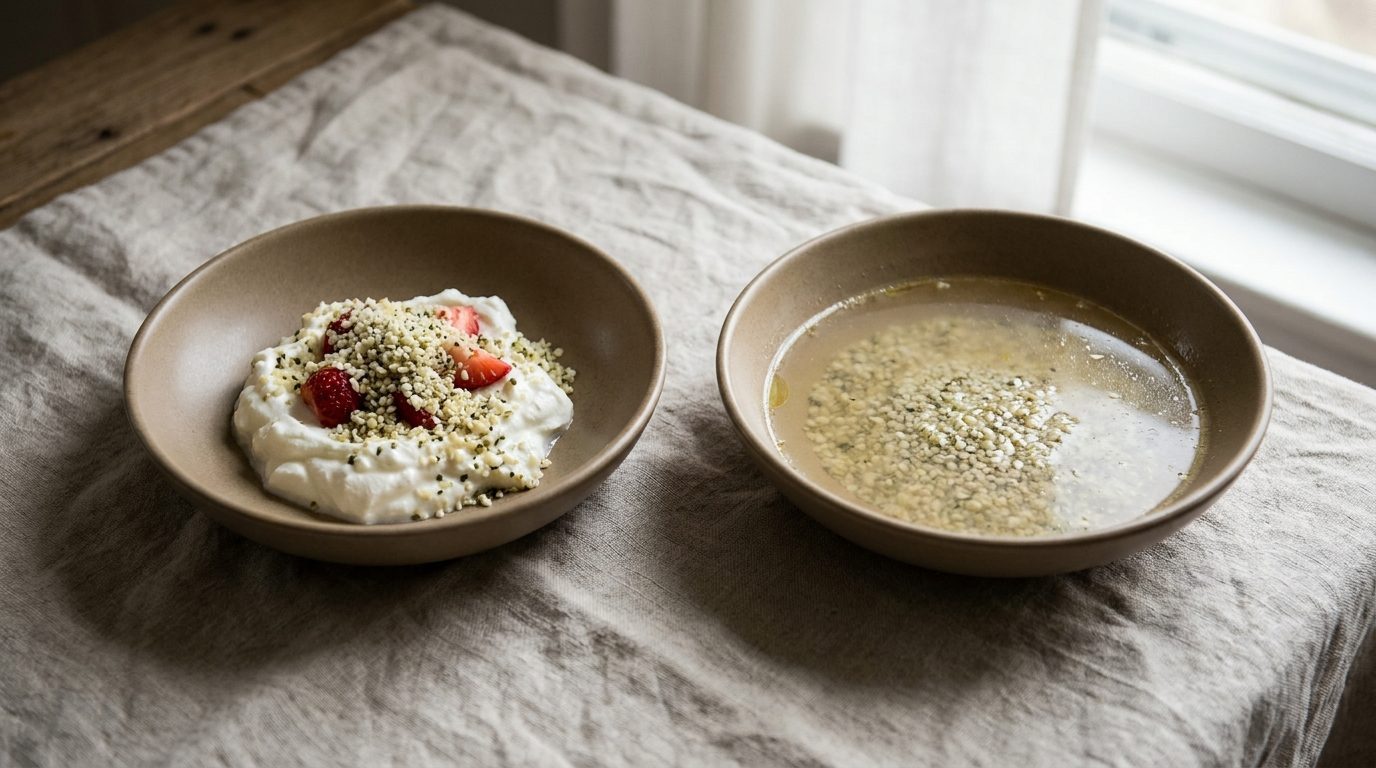
Most people buy hemp hearts, put them on yogourt for a week, and then run out of ideas. The problem is rarely the seed — it is that hemp hearts have a soft texture and a mild flavour, which makes them brilliant in some contexts and quietly wrong in others.
What are you actually working with?
Two properties determine every pairing decision. The first is flavour: hemp hearts taste mildly nutty with a green, slightly grassy edge, and the intensity is low. They will not dominate a dish, but they will not rescue a bland one either. The green note is the part that occasionally clashes — it sits comfortably beside herbs, citrus and dairy and less comfortably beside very sweet, very warm-spiced flavours.
The second is texture, and this is the one people misjudge. Hemp hearts are soft. They do not crunch. Bite into one and it yields immediately, releasing oil. That means they cannot do the job of a toasted nut or a pumpkin seed, and any recipe expecting contrast will feel flat if you substitute them in. What they can do is add a fine, tender body that thickens and enriches without anyone noticing a separate ingredient.
Where do hemp hearts disappear completely?
The best pairings are foods where you want the nutrition and would rather not detect the addition. Soft, moist, already-textured foods swallow hemp hearts entirely:
- Yogourt, kefir and cottage cheese. The dairy tang cancels the green note and the softness matches. This is the reason it is everyone's first use — it genuinely is the easiest.
- Oatmeal and overnight oats. Stirred in after cooking, the hearts hydrate slightly and read as part of the porridge.
- Smoothies. Blending breaks the kernels open, which also releases their fat and makes the drink noticeably creamier. A spoonful does more for body than most thickeners.
- Soups and stews, off the heat. Stirred into a blended soup at the end, they enrich it like a small amount of cream.
- Mashed and pureed foods. Hummus, guacamole, mashed sweet potato, refried beans — all take hemp hearts without complaint.
The common thread is moisture. Hemp hearts in a wet environment integrate. Hemp hearts on a dry surface stay separate and eventually fall off.
Where does the texture fight back?
The failures are predictable once you know the mechanism. Anything that relies on crunch for its identity will be disappointed by a substitution. A salad that wanted toasted almonds will not be fixed by hemp hearts; you will get fat and protein but lose the contrast that made the salad interesting. The workaround is to use both — hearts for nutrition, a small quantity of a genuinely crunchy seed for texture.
Dry surfaces are the other failure case. Hemp hearts scattered on dry toast, a crisp cracker or a plain piece of grilled chicken will roll off before they reach your mouth. They need something to adhere to: a layer of nut butter, avocado, hummus, soft cheese or a dressing. Think of them as needing glue.
The third failure is high, prolonged heat. The fat in hemp hearts is delicate and will turn bitter under a broiler or in hot oil. As a topping added at the end of cooking they are fine. As a coating on something that will be seared or grilled, they are not.
What savoury pairings do people miss?
Hemp hearts got typecast as a breakfast ingredient, which leaves most of their range unused. The savoury applications are frequently better, because the green, grassy note that has to be masked in sweet contexts is an asset in savoury ones.
They belong on any dressed salad — tossed with the dressing rather than sprinkled after, so the oil carries them onto the leaves. They work stirred through warm grains, where the residual moisture holds them and the softness disappears into the rice or farro. They are excellent in place of pine nuts in a herb sauce, where blending is doing the work anyway and the cost difference is substantial. They finish a bowl of soup, they mix into a burger or meatball mixture as an extender, and they go into an egg scramble at the very end of cooking.
Two specific matches are worth trying deliberately: hemp hearts with lemon and olive oil, where the acid lifts the green note into something bright; and hemp hearts with soft herbs — parsley, basil, dill, cilantro — which share the same vegetal register and reinforce each other.
Which combinations are genuinely not worth it?
Very sweet baked goods with heavy warm spice — cinnamon-forward, molasses-rich, deeply caramelized things — do not gain much. The hemp flavour is either lost entirely, in which case you have added fat for no sensory reason, or it reads as slightly off against the sweetness.
Delicate raw preparations that depend on a clean flavour, such as a simple carpaccio or a citrus salad meant to taste of nothing but fruit, are also poor hosts. And anything already very rich — a cream sauce, a fatty cheese dish — gains little, since the main contributions hemp hearts make are fat and body, both of which are already present.
None of these are dangerous or wasteful, just unrewarding. Recipes that lean on the pairings that do work are collected among our articles.
How do you build the habit without thinking about it?
Pick two anchors rather than trying to use hemp hearts everywhere. One should be a repeating breakfast — the same bowl of oats or yogourt you already eat — because repetition is what turns an ingredient into a habit. The other should be a savoury vehicle you make often, most usefully your standard salad dressing, since blending is the single application where hemp hearts add the most and cost the least effort.
Keep the jar where you will see it: on the fridge shelf at eye level rather than behind the condiments, since a cold, dark storage spot is also the right one for the fat. Add them at the end of cooking, give them something moist to cling to, and stop asking them to be crunchy. Get those three things right and hemp hearts stop being a health purchase you feel guilty about and become an ingredient you simply use.