
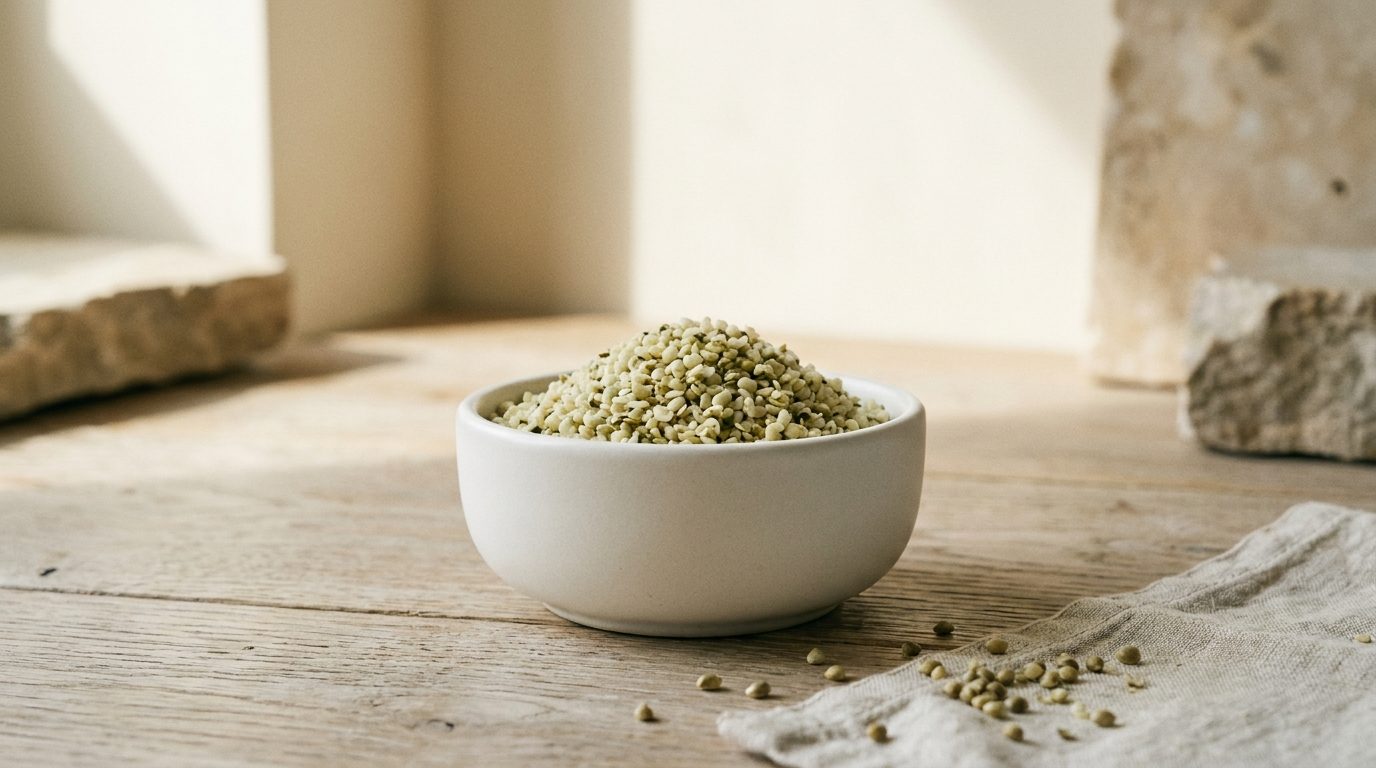
It is the question almost everyone asks before their first spoonful: if hemp hearts come from the same plant as cannabis, do they contain THC, and could they get you high or fail you a drug test? The short answer is reassuring, and the longer answer is worth understanding so you can shop and eat with confidence.
Do hemp hearts contain THC at all?
Hemp hearts are the soft inner kernel of the hemp seed after the hard outer shell has been removed. The seed itself produces essentially no cannabinoids. THC and CBD are made in the resin glands on the plant's flowers and leaves, not inside the seed. So the kernel you eat is not a meaningful source of THC the way a flower or an extract would be.
The trace amounts that do sometimes show up on a seed come from external contamination, not from the seed manufacturing its own THC. During harvest, seeds can brush against resin-bearing flower material, and microscopic amounts can cling to the outside of the shell. This is exactly why dehulling and cleaning matter: removing the shell and washing the seed strips away most of that surface residue, leaving the hemp heart with only negligible traces, if any.
Put plainly: a hemp heart is a food, not a drug. Its job is protein, omega fats, magnesium and a mild nutty flavour, not psychoactivity.
Why hemp hearts cannot get you high
Getting high requires a meaningful dose of delta-9 THC reaching your bloodstream. Two facts make that impossible with hemp hearts:
- The variety is bred to be low in THC. Industrial hemp grown for food in Canada is a regulated, tightly controlled crop. By law it must come from approved low-THC cultivars, which differ genetically from drug-type cannabis.
- The amounts are vanishingly small. Even if a finished product carried faint surface traces, a normal serving of hemp hearts is roughly three tablespoons. The total THC in that serving is far, far below any threshold capable of producing an effect.
For comparison, the cannabinoid content of a hemp heart is in a completely different league from a cannabis edible, which is deliberately formulated to deliver milligram-level doses of active THC. Eating hemp hearts is, in this respect, much closer to eating sunflower seeds or flax than to consuming anything cannabis-derived.
What does Health Canada require?
Hemp foods sold in Canada are not an unregulated grey area. Hemp is grown under federal licence, and seed-derived foods such as hemp hearts are subject to limits on residual THC. Health Canada sets a maximum allowable level of total THC in hemp seed-derived food products, and licensed processors test to confirm their product stays under that ceiling before it reaches store shelves.
The practical effect of this system is that a reputable, properly produced bag of Canadian hemp hearts has already been screened against a legal threshold designed to keep THC at trace levels. You are not relying on luck or on a manufacturer's goodwill alone; you are relying on a tested, enforced standard. This is one of the reasons buying hemp hearts from established Canadian producers is sensible: the regulatory and testing infrastructure behind them is real.
It is worth distinguishing two numbers people sometimes confuse. One is the THC limit in the growing plant that defines a crop as industrial hemp rather than cannabis. The other is the residual THC limit allowed in the finished food. They are separate rules serving separate purposes, and hemp hearts have to satisfy the food standard.
Can hemp hearts make you fail a drug test?
This is the worry that keeps people up at night, especially anyone whose job involves workplace testing. The honest, careful answer is that a single normal serving of properly produced hemp hearts is extremely unlikely to cause a positive result on a standard urine drug screen, but it is not mathematically impossible to register trace metabolites under unusual conditions.
Here is the nuance that matters:
- Standard tests have a cut-off level. Workplace drug screens are not designed to flag any molecule of THC; they look for THC metabolites above a defined concentration. Trace dietary exposure normally falls well below that cut-off.
- Older research used poorly cleaned products. Studies that once raised concern often involved hemp foods from an era with weaker processing and looser limits. Modern, well-cleaned, regulation-compliant hemp hearts carry far less residual THC than those older samples.
- Dose and frequency interact. The theoretical risk rises only with very large, sustained intakes of a poorly processed product, not with everyday culinary use of a quality one.
If you are subject to safety-sensitive or zero-tolerance testing, the prudent move is simple: choose hemp hearts from a reputable Canadian brand that tests its product, keep your intake to normal serving sizes, and, if your employer's policy is strict, ask whether hemp foods are addressed in writing. The food is safe to eat; the only real issue is the small chance of an ambiguous test result, and that is managed through product choice and common sense.
Hemp hearts versus CBD versus cannabis: clearing up the confusion
Much of the anxiety around hemp hearts comes from lumping three very different things together. They are not the same, and the differences explain why hemp hearts are so benign.
| Product | Comes from | THC level | Purpose |
|---|---|---|---|
| Hemp hearts | The seed kernel | Trace at most | Food and nutrition |
| CBD oil / extract | Flower and leaf | Low, but variable | Wellness / supplement |
| Cannabis / marijuana | Flower and leaf | High, intentional | Intoxication / medical |
The key takeaway: hemp hearts are a seed product, while both CBD and cannabis come from the flowering parts of the plant where cannabinoids are actually produced. A bag of hemp hearts and a bottle of CBD oil may both say "hemp" on the label, but they are fundamentally different categories. Hemp hearts are not a low-dose cannabis product and are not marketed for any cannabinoid effect.
Who should still be cautious?
For the vast majority of people, hemp hearts are simply a nutritious food to be enjoyed without a second thought. A few groups may want a little extra care, mainly out of prudence rather than genuine risk:
- Workers under strict or random drug testing, who should favour tested, reputable products and stick to normal servings, as described above.
- Competitive athletes bound by specific anti-doping rules, who should confirm their governing body's stance on hemp foods rather than assume.
- Anyone giving hemp hearts to young children, where the relevant consideration is portion size and overall diet, not THC, since the trace levels involved are not a meaningful concern for ordinary consumption.
Notice that none of these cautions are about getting high, because that genuinely is not on the table with a seed food. They are about test results and good practice.
If you take one thing away, let it be this: buy your hemp hearts from an established Canadian producer that tests against Health Canada's residual-THC standard, keep servings to the usual two or three tablespoons, and enjoy them for what they are, one of the most nutrient-dense plant foods you can sprinkle on a bowl of yogourt. The THC question, once you understand where cannabinoids actually come from, turns out to be one of the easiest food-safety worries to put to rest. For more on what hemp hearts are, how to use them, and how to choose a quality brand, browse our full library of articles.